By Yinka Richards
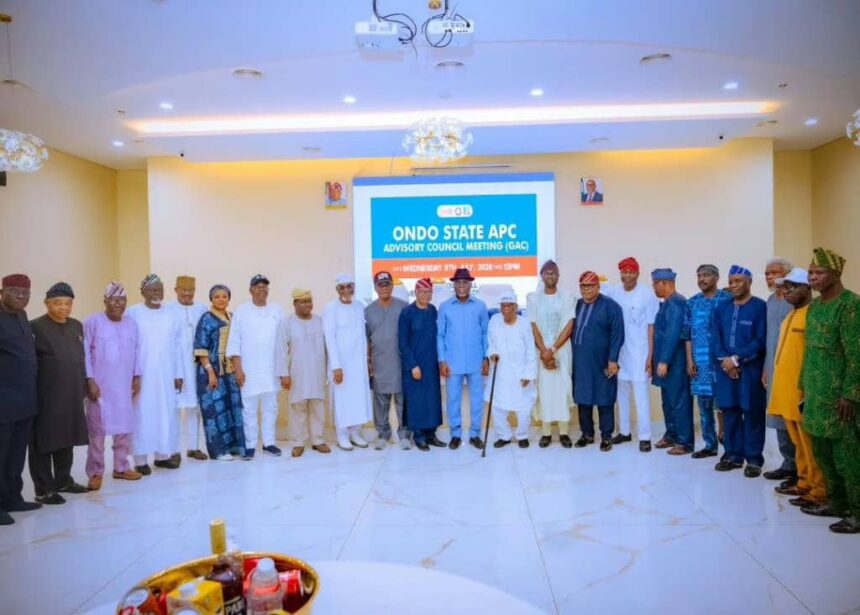
The recent meeting between the Governance Advisory Council (GAC) and Governor Lucky Aiyedatiwa has generated renewed optimism among members of the All Progressives Congress (APC) in Ondo State who are eager to see the party emerge stronger and more united ahead of future political contests. At a time when political cohesion has become indispensable to electoral success, every reconciliation initiative deserves commendation.
However, the sustainability of such efforts will ultimately depend not on ceremonial meetings but on the credibility, inclusiveness, and impartiality of the reconciliation process.
Political reconciliation is far more complex than convening stakeholders around a conference table. It demands rebuilding fractured relationships, restoring confidence among aggrieved party members, and demonstrating through deliberate actions that every legitimate stakeholder has a place within the party.
Without these elements, reconciliation risks becoming symbolic rather than transformational.
One of the critical questions arising from the recent engagement is whether the Governance Advisory Council, despite its respected status, is best positioned to lead such a sensitive assignment. Within every political family exist varying loyalties, alliances, and strategic interests.
Some members of the council are widely perceived to have maintained political preferences or longstanding relationships with particular aspirants and political actors, including figures such as D.I. Kekemeke and Pa Ali Olanusi, among others. Whether these perceptions are accurate or not, they underscore the importance of ensuring that reconciliation is led by individuals or committees whose neutrality commands broad confidence across all tendencies within the party.
Successful reconciliation cannot merely be impartial; it must also be widely perceived as impartial. Political confidence is built not only on fairness but also on the public belief that every stakeholder is receiving equitable treatment.
The governor also bears significant responsibility for determining the success of any peace initiative. Leadership in politics is measured not only by electoral victories or constitutional authority but also by the capacity to accommodate dissent, respect differing opinions, and build bridges across competing interests. As the leader of the APC in Ondo State, Governor Aiyedatiwa occupies a position that requires magnanimity, consultation, and deliberate inclusiveness.
Many party faithful believe that the administration should intensify engagement with respected political leaders across the state, including former Governor Olusegun Mimiko, senior party elders, youth leaders, women groups, grassroots mobilizers, and other influential stakeholders whose contributions continue to shape the political landscape. Constructive engagement with these constituencies could help reduce lingering mistrust and reinforce the party’s collective strength.
Equally important is the conduct of future party primaries and internal elections. Experiences from previous electoral cycles demonstrate that perceptions of exclusion, unequal treatment, or predetermined outcomes often leave deep political wounds that persist long after candidates emerge. It is therefore imperative that party leadership establishes transparent, credible, and universally accepted processes capable of inspiring confidence among all aspirants and their supporters.
Political victory is seldom achieved through numerical strength alone; it is sustained by emotional investment, trust, and a shared sense of belonging. Every aspirant who enters a contest deserves to leave with the conviction that the process was fair, even in defeat.
The APC remains one of Nigeria’s strongest political platforms, but maintaining that strength in Ondo State will require a conscious commitment to internal democracy, inclusive leadership, and respect for diverse political tendencies.
Reconciliation should not be viewed as the responsibility of one committee or one leader alone. Rather, it should become a collective undertaking involving respected elders, elected officials, former office holders, youth representatives, women leaders, professionals, and independent voices capable of inspiring confidence across the political spectrum.
Ultimately, history shows that political parties flourish when leaders prioritize consensus over confrontation, dialogue over division, and inclusion over exclusion. The recent GAC meeting should therefore be regarded not as the conclusion of the reconciliation process but as its beginning. The true measure of success will lie in the willingness of all stakeholders especially those entrusted with leadership to embrace humility, fairness, and statesmanship in the larger interest of the APC and the people of Ondo State.
Yinka Richards is the former Special Assistant to Ondo State Governor on Special Duties and National Cordinator of Renewed Hope Street Crusaders.